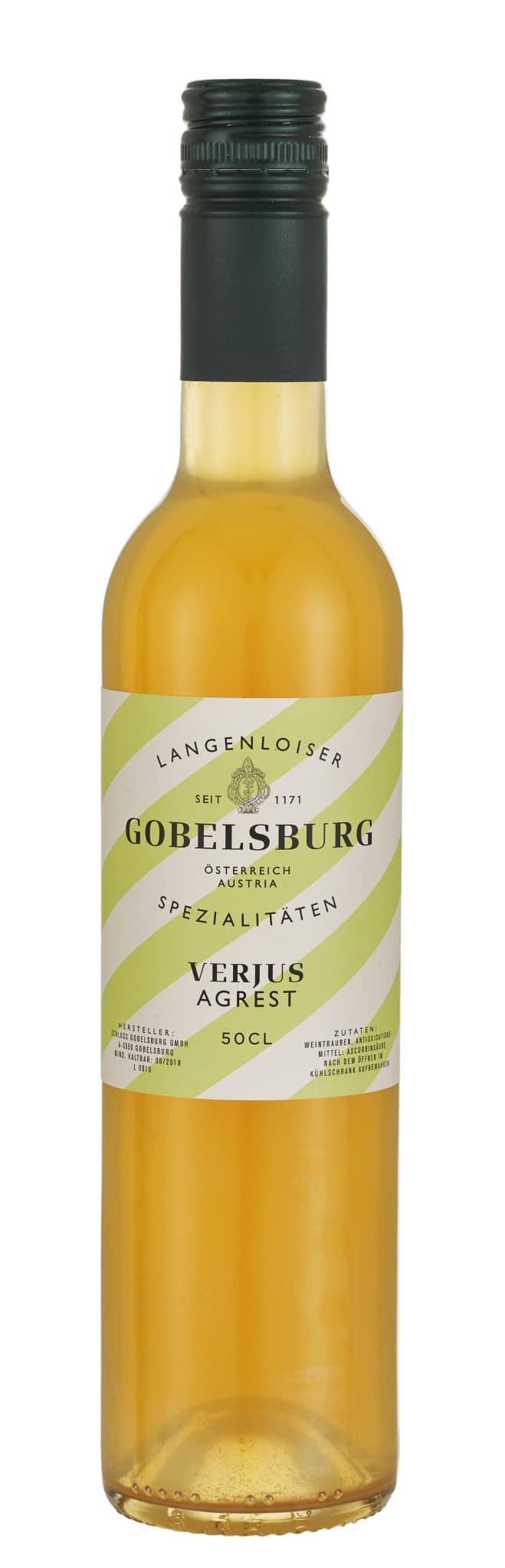
Verjuice
Gobelsburg specialities;
Agrest
Verjuice – deriving from the french verjus, formerly “vert jus”, meaning juice from green grapes. Verjuice is a souring and seasoning condiment that has been around for centuries. It can be used in many ways for salad dressings, sauces, to round off stews or roasts and even ice cream. It has now returned to many kitchens. Even more important it makes an appearance on beverage lists, beeing – mixed with water or sodawater – a refreshing, non-alcoholic alternative.
- 0,5
Litres
Bottle size
€8,10 incl. VST
The healing power of Verjuice was already known in ancient Greek. Around 400
B.C. Hippokrates from the island of Kos reports about the use of Verjuice in
medicine and in the middle ages it was well known all around Europe
and used for cooking and seasoning and also known for its soothing and digestive qualities. Once the crusaders brought the lemon to Europe, the use of Verjuice lessened. In the Near East nevertheless its use has never vanished. The original Dijon mustard is also produced using Verjus instead of
vinegar. Never forgotten in french recipes and kitchens it made a return all over Europe in past years.
A quality oriented vintner usually cuts half of the grape bunch to allow more aeration and achieve healthy grapes. This is usually done for white and red grapes before they ripen, store sugar and change colour. These unripe, green grapes are being pressed, thereafter the juice is pasteurized to conserve it, but not filtered. A mildly sour juice, free from preservatives and additives is the result. The acidity is softer than vinegar, the aroma is different and more elegant compared to lemon juice.
A quality oriented vintner usually cuts half of the grape bunch to allow more aeration and achieve healthy grapes. This is usually done for white and red grapes before they ripen, store sugar and change colour. These unripe, green grapes are being pressed, thereafter the juice is pasteurized to conserve it, but not filtered. A mildly sour juice, free from preservatives and additives is the result. The acidity is softer than vinegar, the aroma is different and more elegant compared to lemon juice.
History & Production
The healing power of Verjuice was already known in ancient Greek. Around 400
B.C. Hippokrates from the island of Kos reports about the use of Verjuice in
medicine and in the middle ages it was well known all around Europe
and used for cooking and seasoning and also known for its soothing and digestive qualities. Once the crusaders brought the lemon to Europe, the use of Verjuice lessened. In the Near East nevertheless its use has never vanished. The original Dijon mustard is also produced using Verjus instead of
vinegar. Never forgotten in french recipes and kitchens it made a return all over Europe in past years.
A quality oriented vintner usually cuts half of the grape bunch to allow more aeration and achieve healthy grapes. This is usually done for white and red grapes before they ripen, store sugar and change colour. These unripe, green grapes are being pressed, thereafter the juice is pasteurized to conserve it, but not filtered. A mildly sour juice, free from preservatives and additives is the result. The acidity is softer than vinegar, the aroma is different and more elegant compared to lemon juice.
A quality oriented vintner usually cuts half of the grape bunch to allow more aeration and achieve healthy grapes. This is usually done for white and red grapes before they ripen, store sugar and change colour. These unripe, green grapes are being pressed, thereafter the juice is pasteurized to conserve it, but not filtered. A mildly sour juice, free from preservatives and additives is the result. The acidity is softer than vinegar, the aroma is different and more elegant compared to lemon juice.